OUR ACTIONS
Funding of scientific projects
Our calls for projects (AAPs)
The Foundation For Rare Diseases supports excellent research to understand the causes and pathophysiological mechanisms of rare diseases, to develop new treatments, and to improve the lives of patients.
The Foundation has an active scientific policy and launches 4 to 6 calls for projects per year. It offers funding to winning research teams and access to innovative technologies such as new generation sequencing (exomes, whole genomes and new technologies of interest in this field), the development of animal models, and high-throughput screening of molecules with therapeutic potential. Expertise in these new technologies is provided by specialized technology platforms.
List of winning projects and models funded by the Foundation
Access the search engine for award recipients since 2012, as well as the rare disease models funded by the Foundation
Current calls for projects
PARTNERSHIP RESEARCH GRANT
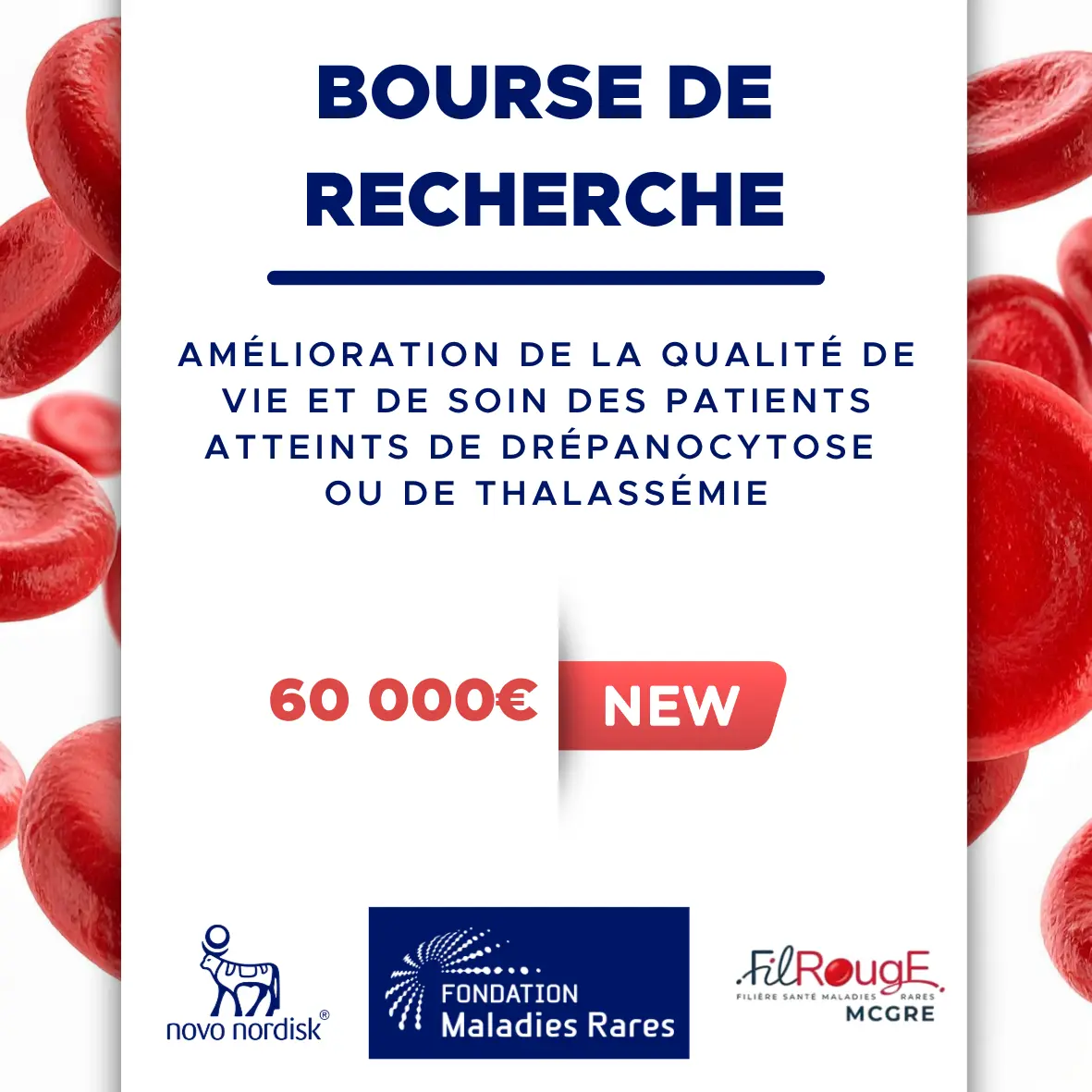
Novo Nordisk Research Grant –“Improving the Quality of Life and Care for Patients with Sickle CellDisease , orThalassemia”
The Rare Diseases Foundation and the FilRougE-MCGRE Rare Diseases Healthcare Network have once again joined forces, with financial support from Novo Nordisk, to offer a research grant in the Humanities and Social Sciences (HSS) to support a research project aimed at improving the quality of life and/or care for patients with sickle cell disease or thalassemia.
Maximum budget: €60,000
Maximum duration: 24 months
Submission deadline: September 24, 2026, at 12:00p.m .(Paris time).
JOINT CALL FOR PROJECTS
Call for Proposals:CMT France –“Charcot-Marie-Toothdisease”
Given the unique challenges of the rare disease field, CMT France and the Rare Diseases Foundation have formed a partnership to support and promote research on CMT.
Maximum budget: €25,000
Maximum duration: 24 months
⚠️ New submission deadline : September 22, 2026, 5:00 p.m.(Paris time).
Partner platforms
For its Calls for Projects on high throughput sequencing, screening and the creation of animal models, the Foundation relies on partner platforms of expertise. We invite you to contact these platforms directly to set up your projects.
Rare Diseases and Pain Prize - APICIL Foundation
Since 2022, the APICIL Foundation has joined forces with the Foundation For Rare Diseases to reward an innovative project in the field of rare diseases and pain by offering a "Rare Diseases and Pain" prize of €15,000.
This prize, awarded to the project leader, enables a French research team to develop a research project on this theme that is so important for patients and is sometimes still too little studied.
Rare Diseases and Pain Award - ALNYLAM
Since 2020, Alnylam Pharmaceuticals has been committed to the Foundation For Rare Diseases to reward innovative projects using RNA interference technology in the field of rare diseases.
Each year, a €20,000 prize is awarded to an established researcher, scientific leader of a team attached to a French research organization, who has contributed through his or her research to major advances in the field of rare diseases.